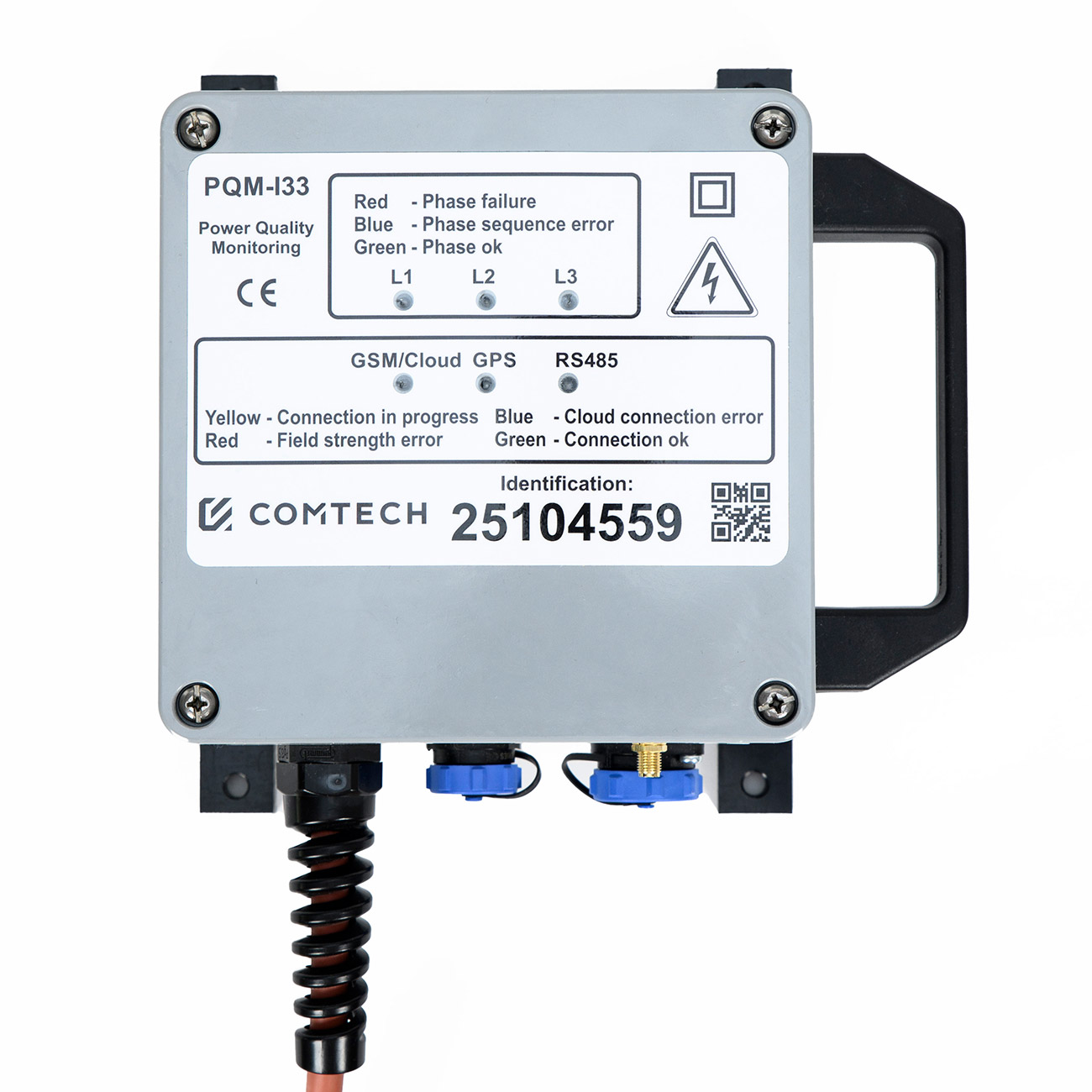
The purpose of the COMTECH PQM-I is real-time monitoring of medium-voltage and low-voltage networks, furthermore finding quickly the existing and potential fault locations. The device has a compact design, it contains the measuring and analyzing unit, the power supply as well as the communication circuit. Two main types are available, the PQM-I3x that should be placed directly at the transformer, and the PQM-I30 that should be placed at the end of the line. Both versions can be connected to a network connection point built by an electrician with live work permit without breaking the circuit or shutdown. In this case the connection can be done without live work permit as well.
The base devices installed to perform primarily casual measurements are suitable for measuring the RMS voltage of the investigated network section in all the three phases, for determining the total harmonic distortion and voltage unbalance with an averaging period of 1 minute. The PQM-I30 completes this by performing flicker-measurement, while the PQM-I3x allows measuring RMS current in each phase (and in the neutral wire if required) with calculating the harmonic content, furthermore the active and reactive energy flow with direction information, also using 1 minute averaging (based on the ordered options).
Both types are able to store the rapid voltage change values classified into categories, as well as registering events about the extent of voltage dips and swells. These are stored not only on the local storage medium with a capacity of more than a year, but also can be forwarded to a central database. If the event is a voltage interruption, the message with these information will still forwarded – thanks to the built-in power supply fed from the measured network, which keeps the device alive at least for 5 seconds after the powering was cut off. The powering is ensured from the measured network. If any of the phases provides at least 70 V, the device can work stabile.
In order to avoid unauthorized access, the registered data as well as the settings are available only via a secured remote session. The communication chain can be changed to an another one (with another standard) if required, is based on a GSM module supporting LTE/NB-IoT/Cat-M/2G modes, and forwards the data into a cloud database using standard TCP/IP and MQTT protocols. The events can be synchronized to a time server or to GNSS, the positioning is done using GNSS.
The devices mounted into a robust portable housing are available with a wide range of options, as can be seen in the chart below.
Benefits:
- Compact design – measurement, powering and communication in a single unit
- Real-time clock synchronized to GNSS or to a time server
- Local data storing of 365+ days
- High data security – secured remote data access only
- Replaceable LTE/NB-IoT/Cat-M/2G communication module