

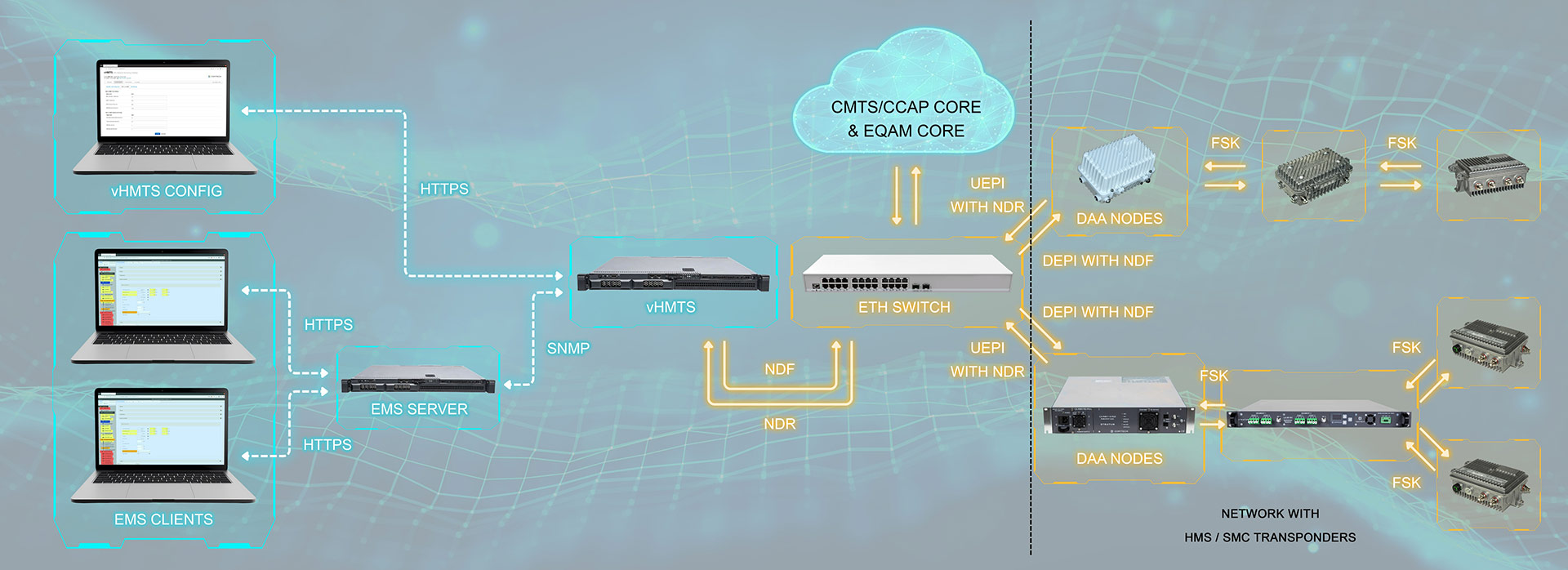
Continuous monitoring of active network elements remains essential in DAA-based access networks to maintain a high level of service availability. However, replacing existing narrowband monitoring solutions based on HMS/SNMP or SMC/TNCS is not always economically justified, particularly where the existing infrastructure can continue to provide reliable service.
COMTECH’s vHMTS addresses this challenge by utilizing the standardized OOB channel of DAA networks. Unlike conventional hardware-based HMTS gateways, the solution generates and transports the narrowband RF signals directly in digital form: carrier samples are encapsulated into L2TP packets and delivered to the RPD/RMD, where the actual RF signal is generated. This reduces hardware requirements, power consumption and potential points of failure, while the virtualized architecture also makes system expansion considerably simpler.
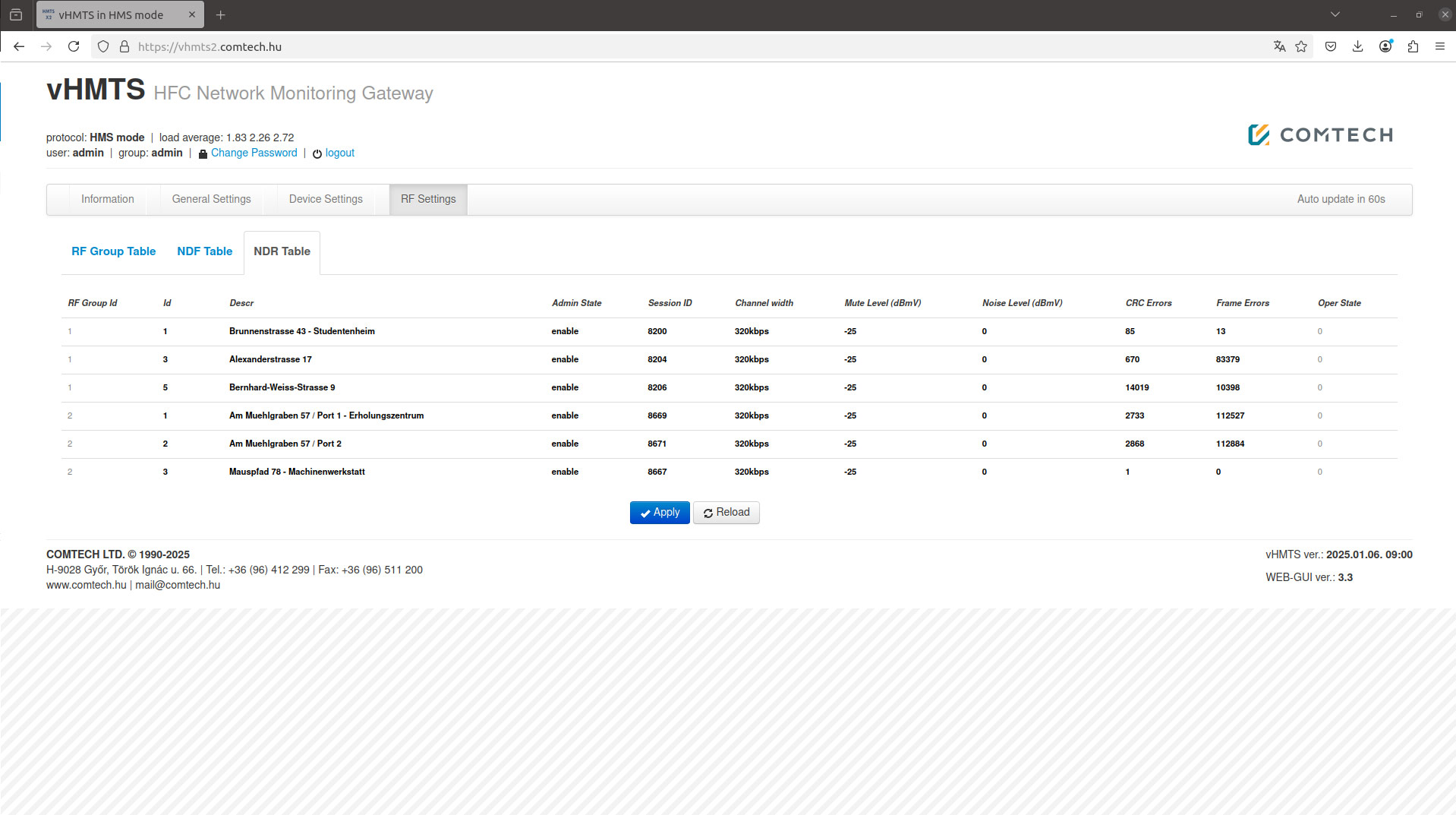
The vHMTS supports HMS, SMC/TNCS and COMTECH’s proprietary monitoring protocol, with switching between the protocols possible at any time. Tests performed on a server with a 4-core, 3.5 GHz processor demonstrated reliable operation with four RPDs while keeping per-core CPU utilization below 25%. A single RF group can manage up to 1000 network elements, while additional RF groups can be added by increasing the available processing capacity.
Compatibility has been verified with DAA equipment from Harmonic and Vecima. The vHMTS can be delivered as a preconfigured virtual machine, eliminating the need for on-site hardware installation. Its web-based configuration interface, SNMPv3 and IPv6 support, LDAP-based centralized user management and multiple authorization levels make the solution well suited to the requirements of modern network management environments.
A detailed technical article on the subject was published in the May 2026 issue of Cable!Vision.
Cable!Vision is a professional journal for the cable, fiber-optic and IPTV community, now in its 21st year of publication. Its pages feature leading manufacturers, research and development companies, and service providers presenting their latest technical solutions and case studies, complemented by articles covering the industry’s business and regulatory trends.
The full article is available as a PDF at the following link: